
Samarkand travel guide
Samarkand — Timur's capital and the most famous city of the Silk Road.
- RegionSamarkand
- Time needed2–3 days
- Nearest airportSamarkand International Airport (SKD)
- Best monthsApril, May, September, …
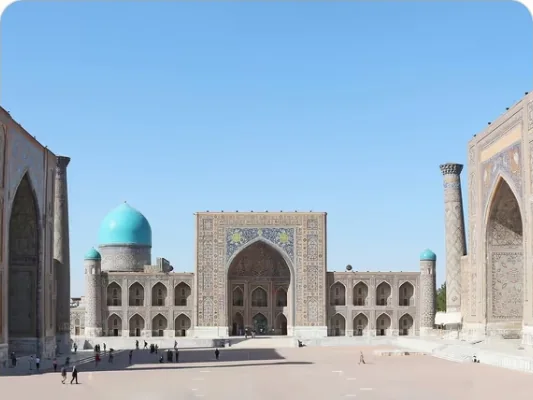
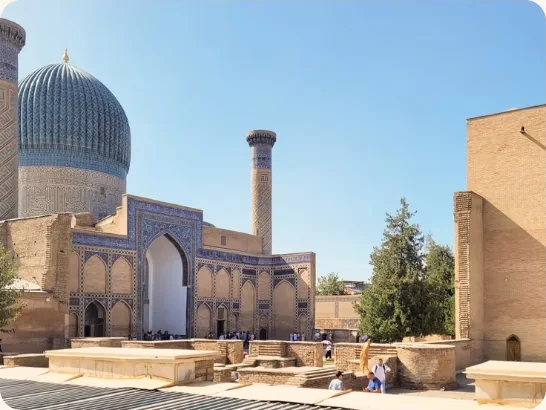
Samarkand is the city most travelers picture when they think of Uzbekistan: the three tiled madrasas of the Registan, the ribbed blue dome of Gur-e-Amir where Timur is buried, and the street of mausoleums at Shah-i-Zinda. The historic centre is a UNESCO World Heritage Site under the name 'Samarkand – Crossroad of Cultures'.
The city is older than Rome — the ancient settlement of Afrosiyob on its northern edge goes back to at least the 7th century BC — but most of what you see today was built by Timur (Tamerlane) and his grandson Ulugh Beg in the 14th and 15th centuries. A private guide makes the difference here: the monuments are large and the stories behind them, from Bibi-Khanym's legend to Ulugh Beg's star catalogue, are what bring them to life.
History in brief
Known to the Greeks as Marakanda, Samarkand was captured by Alexander the Great in 329 BC, flourished as a Sogdian trading city, was destroyed by Genghis Khan in 1220 and rebuilt by Timur as the capital of his empire in 1370. Under Ulugh Beg it became a centre of science and astronomy. Later the capital moved to Bukhara, and in 1868 the city came under Russian rule.
Top sights in Samarkand
- Registan SquareThe Registan is the symbol of Samarkand and one of the great public squares of the Islamic world. Three…
- Gur-e-Amir MausoleumGur-e-Amir is the tomb of Amir Timur, his sons Shahrukh and Miran Shah, his grandsons Ulugh Beg and Muhammad…
- Shah-i-ZindaShah-i-Zinda — 'the living king' — is a street of more than twenty mausoleums climbing the slope of the old…
- Bibi-Khanym MosqueBibi-Khanym was Timur's most ambitious project: a congregational mosque built after his Indian campaign of…
- Ulugh Beg ObservatoryUlugh Beg, Timur's grandson, ruled Samarkand and was one of the greatest astronomers of the 15th century. His…
- Siab BazaarSiab is Samarkand's main bazaar, right next to Bibi-Khanym. It is the place to buy the city's famous bread,…
- Afrosiyob MuseumThe grassy hills north of the centre hide Afrosiyob, the site of ancient Samarkand from at least the 7th…
- Tomb of Daniel (Khoja Daniyar)On the bank of the Siab stream at the foot of Afrosiyob stands an 18-metre-long tomb said to contain relics…
- Hazrat Khizr MosqueThis small mosque on a hill opposite Bibi-Khanym is believed to stand on the site of the first mosque built…
- Konigil Paper Mill (Meros)Samarkand was famous for paper from the 8th century, when the secret of paper-making is said to have reached…
- Imam al-Bukhari ComplexImam al-Bukhari (810–870) compiled the Sahih al-Bukhari, considered by Sunni Muslims the most authentic…
- Rukhabad MausoleumRukhabad is one of the oldest monuments in Samarkand, a plain brick mausoleum built by Timur for the Sufi…
- Eternal City (Silk Road Samarkand)The Eternal City is part of the new Silk Road Samarkand tourist complex on the city's eastern edge. It…
How to get to Samarkand
Afrosiyob high-speed trains reach Samarkand from Tashkent in about 2 hours and from Bukhara in about 1.5 hours. Samarkand airport has international and domestic flights. By road it is around 310 km from Tashkent and 270 km from Bukhara.
Getting around
The main monuments — Registan, Bibi-Khanym, Siab Bazaar and Shah-i-Zinda — sit along one walkable axis. Gur-e-Amir is a short walk from the Registan. The Ulugh Beg Observatory, the Afrosiyob museum and the Konigil paper mill are best reached by car.
Best time to visit
April–May and September–October. In summer start at 7–8 am and return to the monuments for sunset.
Month by month: Jan · Feb · Mar · Apr · May · Jun · Jul · Aug · Sep · Oct · Nov · Dec
Things to do
- See the Registan at sunrise and again lit up at night
- Walk the stairway of Shah-i-Zinda
- Visit Timur's tomb at Gur-e-Amir
- Watch silk paper being made by hand at Konigil
- Buy bread and dried fruit at Siab Bazaar
- Learn how Ulugh Beg measured the year at his observatory
What to eat
- Samarkand non — heavy, glossy round bread famous across the country
- Samarkand-style plov, cooked in layers with yellow carrots
- Shashlik at the Siab Bazaar area
- Halva and parvarda sweets
- Fresh fruit in season: apricots in June, grapes and melons from July
Day trips and side trips
- ShakhrisabzTimur's birthplace, 90 km south over the Takhtakaracha pass
- Imam al-Bukhari complexa major pilgrimage site 25 km north
- Urgut bazaar and plane treesa weekend mountain bazaar 40 km east
Plan your visit to Samarkand
- Private guide in SamarkandLicensed local guides, 9 languages
- Things to do in SamarkandFull list of sights and experiences
- Food in SamarkandDishes and where to try them
- Samarkand in 1 dayReady-made itinerary
- Samarkand in 2 daysReady-made itinerary
- Samarkand in 3 daysReady-made itinerary
- Samarkand to TashkentDistance, train, car
- Samarkand to BukharaDistance, train, car
- Samarkand to KhivaDistance, train, car
- Samarkand to NukusDistance, train, car
Frequently asked questions
How many days do I need in Samarkand?
Plan 2–3 days for Samarkand. Add a day for side trips.
What is the best time to visit Samarkand?
April–May and September–October. In summer start at 7–8 am and return to the monuments for sunset.
How do I get to Samarkand?
Afrosiyob high-speed trains reach Samarkand from Tashkent in about 2 hours and from Bukhara in about 1.5 hours. Samarkand airport has international and domestic flights. By road it is around 310 km from Tashkent and 270 km from Bukhara.
Can I hire a private guide in Samarkand?
Yes. We work with licensed local guides in Samarkand who speak English, Russian and other languages. Send a request with your dates.
Plan your trip with a local guide
Tell us your dates, cities and group size and we will match you with a licensed local guide.
Request a private guide Contact us