
Bukhara travel guide
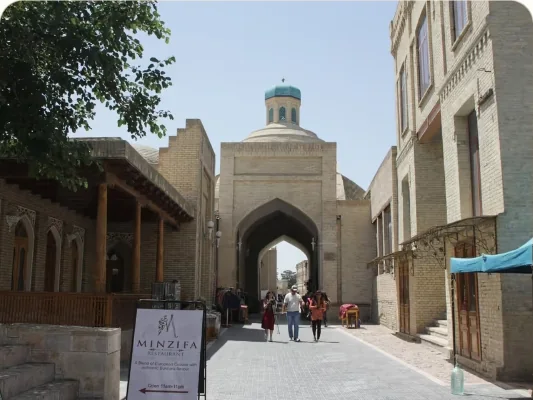
Bukhara — a living old town of domes, minarets and trading arcades.
- RegionBukhara
- Time needed2–3 days
- Nearest airportBukhara International Airport (BHK)
- Best monthsApril, May, September, …
Bukhara is the best-preserved medieval city in Central Asia. Its historic centre — a UNESCO World Heritage Site — has more than 140 protected monuments, and unlike Samarkand's grand ensembles they are woven into a lived-in old town of narrow lanes, family guesthouses and covered bazaars.
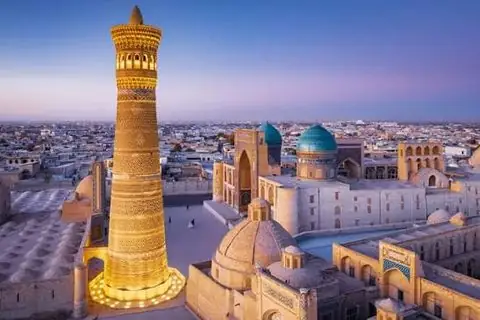
The heart of the city is the Poi Kalyan ensemble with the 47-metre Kalyan Minaret, which even Genghis Khan spared. A few minutes away are the Ark fortress of the emirs, the Lyabi-Hauz pool shaded by mulberry trees, and the 10th-century Ismail Samani Mausoleum. Bukhara is a city to walk slowly; a private guide helps you find the courtyards and stories you would otherwise pass by.
History in brief
Bukhara was a major centre of the Samanid state in the 9th–10th centuries, when scholars such as Avicenna (Ibn Sina) worked here. It was sacked by the Mongols in 1220 and revived under the Shaybanids in the 16th century, when much of today's old town was built. From the 18th century it was the capital of the Emirate of Bukhara, which lasted until 1920.
Top sights in Bukhara
- Poi Kalyan ComplexPoi Kalyan — 'at the foot of the Great' — is the religious heart of Bukhara. The Kalyan Minaret, built in…
- Ark of BukharaThe Ark is a massive earthen fortress that was the residence of Bukhara's rulers for more than a thousand…
- Lyabi-HauzLyabi-Hauz — 'by the pool' — is the social centre of old Bukhara. The pool, built in 1620, is surrounded by…
- Ismail Samani MausoleumBuilt for the Samanid ruler Ismail Samani and his family around 900–950, this small cube of baked brick is…
- Chor MinorChor Minor — 'four minarets' — is the surviving gatehouse of a madrasa built in 1807 by the merchant Khalif…
- Sitorai Mokhi-KhosaSitorai Mokhi-Khosa — 'palace of moon-like stars' — was the summer residence of the last emirs of Bukhara,…
- Magoki-Attori MosqueMagoki-Attori is the oldest surviving mosque in Bukhara. Its carved brick and terracotta façade from the 12th…
- Bolo Hauz MosqueOpposite the Ark, Bolo Hauz was the Friday mosque of the emirs. Its tall veranda (aivan), supported by twenty…
- Chashma-Ayub MausoleumChashma-Ayub — 'Job's spring' — is built over a spring which, according to legend, the Prophet Job (Ayub)…
- Ulugbek and Abdulaziz Khan MadrasasThe Ulugbek Madrasa of 1417 is the oldest surviving madrasa in Central Asia, built by the astronomer-ruler…
- Trading Domes of BukharaBukhara's four surviving trading domes were built in the 16th century at the crossroads of the main streets:…
- Bahauddin Naqshband ComplexBahauddin Naqshband (1318–1389) founded the Naqshbandi Sufi order, which spread from Bukhara across the…
- Chor-Bakr NecropolisChor-Bakr, about 6 km west of Bukhara, is a 'city of the dead' built around the tomb of Abu Bakr Said, a…
- Fayzulla Khodjaev HouseThis richly decorated house belonged to a wealthy merchant family; their son Fayzulla Khodjaev became head of…
How to get to Bukhara
Afrosiyob high-speed trains connect Bukhara with Samarkand (about 1.5 hours) and Tashkent (about 4 hours). Bukhara airport has flights from Tashkent and several international routes. Khiva is about 450 km away — a 6–7 hour drive across the Kyzylkum desert, or a regular train.
Getting around
The old town is compact and almost entirely walkable. A car is useful for Sitorai Mokhi-Khosa, the Bahauddin Naqshband complex and Chor-Bakr, which lie on the outskirts.
Best time to visit
April–May and mid-September to October. Late May often hosts the Silk and Spices Festival.
Month by month: Jan · Feb · Mar · Apr · May · Jun · Jul · Aug · Sep · Oct · Nov · Dec
Things to do
- Climb up to the Ark fortress and see the emirs' throne hall
- Watch the Kalyan Minaret light up at dusk
- Shop for suzani and knives in the trading domes
- Visit a blacksmith or a miniature painter in their workshop
- Spend an evening at Lyabi-Hauz
- Join a folk show at the Nadir Divan-Begi madrasa
What to eat
- Bukhara plov (with chickpeas and raisins)
- Oshi sofi and other local plov styles
- Tea and sweets by the Lyabi-Hauz pool
- Gijduvan shashlik and ceramics on the road towards Navoi
- Bukhara halva and nisholda
Day trips and side trips
- Sitorai Mokhi-Khosathe emir's summer palace
- Gijduvan ceramics workshopfamily pottery 45 km north-east
- Nurata and Aydarkul lakedesert yurt camp and a mountain town
Plan your visit to Bukhara
- Private guide in BukharaLicensed local guides, 9 languages
- Things to do in BukharaFull list of sights and experiences
- Food in BukharaDishes and where to try them
- Bukhara in 1 dayReady-made itinerary
- Bukhara in 2 daysReady-made itinerary
- Bukhara in 3 daysReady-made itinerary
- Bukhara to TashkentDistance, train, car
- Bukhara to SamarkandDistance, train, car
- Bukhara to KhivaDistance, train, car
- Bukhara to NukusDistance, train, car
Frequently asked questions
How many days do I need in Bukhara?
Plan 2–3 days for Bukhara. Add a day for side trips.
What is the best time to visit Bukhara?
April–May and mid-September to October. Late May often hosts the Silk and Spices Festival.
How do I get to Bukhara?
Afrosiyob high-speed trains connect Bukhara with Samarkand (about 1.5 hours) and Tashkent (about 4 hours). Bukhara airport has flights from Tashkent and several international routes. Khiva is about 450 km away — a 6–7 hour drive across the Kyzylkum desert, or a regular train.
Can I hire a private guide in Bukhara?
Yes. We work with licensed local guides in Bukhara who speak English, Russian and other languages. Send a request with your dates.
Plan your trip with a local guide
Tell us your dates, cities and group size and we will match you with a licensed local guide.
Request a private guide Contact us